

Are Weighted Balls for Beginner Pitchers Worth It?
Posted by Editorial Team on 2026 Oct 26th
Last Updated: October 26, 2026
Quick Summary
Weighted balls for beginner pitchers are training tools that weigh more or less than a regulation five-ounce baseball, used to build arm strength, sharpen mechanics, and add controlled overload to a throwing program. Beginners should stay in a working range of roughly 3oz to 7oz and build a stable, coached throwing pattern before adding load.
- Run two to four weeks of regulation catch play before starting weighted sessions.
- Keep weighted throwing to twice a week at most, on non-consecutive days.
- Cap weighted throws at roughly 20 to 30 per session.
- Do not jump more than about two ounces between balls in a single session.
- Stop immediately on sharp elbow or shoulder pain, numbness, or tingling.
Table of Contents
- What Weighted Balls Do for a Beginner Pitcher
- Choosing Plyo Ball Weights for Pitching as a Beginner
- Weighted Ball Drills for Pitchers: Throwing vs. Med-Ball Work
- Building a Weighted Ball Throwing Program With Exact Workload Limits
- Pitcher Arm Care Exercises and Warm-Ups Before Weighted Work
- Weighted Ball Risks, Warning Signs, and When to Stop
- Pick Your First Weighted Ball Set and Start Throwing
- Frequently Asked Questions
What Weighted Balls Do for a Beginner Pitcher
Weighted balls for beginner pitchers are training tools that weigh more or less than a regulation five-ounce baseball, used to build arm strength, sharpen mechanics, and add controlled overload to a throwing program. The arm adapts to whatever load you give it, provided the load is introduced gradually and paired with rest.
Here is the honest version most guides skip. Weighted-ball training is not a shortcut to velocity. It is a stimulus. The ball weight changes how the arm moves through the throwing pattern, and that change is either coached well or it is not.
USA Baseball's amateur pitching guidelines frame youth throwing volume around age and recovery, which is the right lens for anyone starting weighted work.
How Weighted Balls May Affect Throwing Velocity
Velocity gains from weighted implements are widely reported but inconsistently measured. The mechanism is overload: a slightly heavier ball forces the arm to produce more force, while a lighter ball lets the arm move faster than it can with a regulation ball. Both directions train something useful.
What most guides miss is that the speed you gain from a light ball only transfers to the mound if you also throw a regulation ball in the same session. Without that transfer step, you get a pitcher who is fast with a plyo ball and unchanged with a game ball.
Watch out: chasing velocity numbers with weighted balls before mechanics are stable is the single most common way beginners get hurt. Build the pattern first, then add load.
Choosing Plyo Ball Weights for Pitching as a Beginner
Weight selection is the first decision a beginner has to get right, and most guides answer it with a product list instead of a rule. Here is the rule: pick weights relative to the regulation five-ounce baseball, and stay close to it. A beginner's working range is roughly 3oz to 7oz.
Before you pick a weight, run this readiness checklist. If you cannot check every box, spend two to four weeks on regulation catch play first and come back.
- Pain-free throwing with a five-ounce baseball for at least two consecutive weeks
- A repeatable throwing motion a coach has watched and approved
- Consistent command: most throws to a partner or net land in a catchable window
- No soreness that lasts past the day after throwing
- A coach, parent, or trainer who will supervise weighted sessions
Age matters here. Youth and high school pitchers are still growing, and throwing volume should be framed around age and recovery rather than around how much load the arm can tolerate on a given day. USA Baseball's amateur pitching guidelines is the right starting reference for youth throwing volume.
Heavier vs. Lighter Balls: What Each Weight Range Does
| Ball Type | What It Trains | Beginner Use |
|---|---|---|
| Underweight (3oz, 4oz) | Arm speed, release quickness | High intent, low volume |
| Regulation (5oz) | Transfer and command | Every session |
| Overweight (6oz, 7oz) | Arm strength, deceleration control | Low volume, controlled |
| Heavy (9oz, 11oz) | Advanced overload | Coach-supervised only |
The table is the whole weight-selection decision in one place. Lighter balls teach the arm to move fast. Heavier balls teach it to absorb force. Beginners need far more of the first than the second.
Two rules keep weight selection safe. First, do not jump more than about two ounces between balls in a single session; large jumps change the throwing pattern faster than a beginner can control it. Second, do not live at the extremes. A beginner who throws only 3oz balls gets fast without learning to transfer that speed to a game ball, and a beginner who throws only 9oz balls loads the arm before the pattern is stable. The regulation ball is the anchor of every session, not an afterthought.
Weighted Ball Drills for Pitchers: Throwing vs. Med-Ball Work
Weighted ball drills for pitchers fall into two categories that people constantly confuse: throwing drills with weighted baseballs, and medicine ball throws that never leave your hands as a pitch.
Throwing drills use a weighted baseball thrown to a partner or net at game intent, and they train the actual pitching pattern. Med-ball throws use a heavier ball held with both hands and thrown into a wall or rebounder, and they train the torso and hips without loading the elbow and shoulder the same way.
A common mistake is substituting med-ball work for throwing work and calling it a weighted-ball program. It is not. Med-ball throws build the engine. Weighted baseball throws build the delivery. For weight selection and a complete throwing routine, read the Plyo Balls Baseball: Complete Training Guide.
Building a Weighted Ball Throwing Program With Exact Workload Limits
A beginner weighted ball throwing program should run twice a week at most, on non-consecutive days, with a hard cap of roughly 20 to 30 weighted throws per session. That is the entire prescription. Everything else is detail.
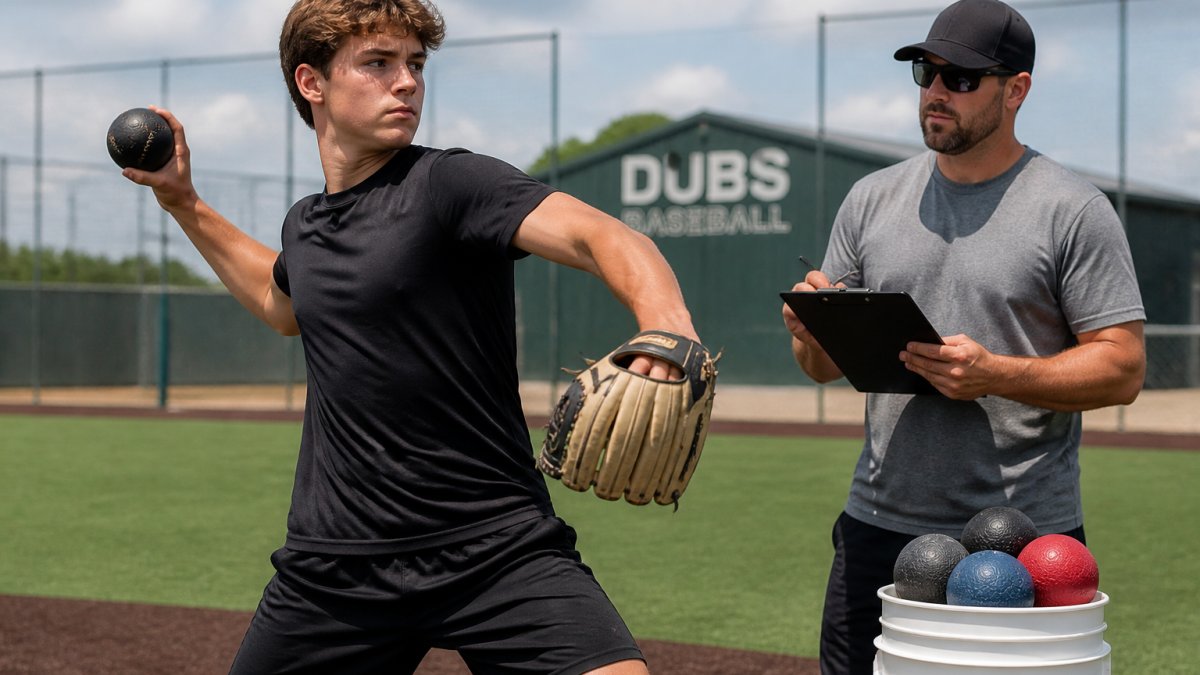
Prerequisites come first. Do not start this program until you can throw a regulation baseball pain-free, with a coached and repeatable motion, for two weeks of normal catch play.
DWB-PP - Real Leather Weighted Ball Set - 3oz., 4oz., 6oz., 7oz., 9oz., 11oz. →
Here is how a week could be structured:
- Session A: warm-up, 10 throws with a 4oz ball at moderate intent, 10 throws with a 6oz ball at controlled intent, finish with 10 regulation throws
- Session B: warm-up, 15 throws with a 3oz ball at high intent, 15 regulation throws
- Everything else: normal catch play and rest
Rest rules are not optional. Keep at least one full day between weighted sessions, and treat any day with lingering soreness as a rest day regardless of the schedule. Stop counting when form breaks.
Progression should be slow and boring. A common pattern is to hold the same workload for two to three weeks, then add five throws to one session, not both.
Measure progress on more than velocity. Velocity is the number everyone watches, but it is the least reliable early signal. Track these instead:
- Workload tolerance: can you complete the session without form breaking down?
- Command: are regulation throws landing where you intend?
- Mechanics: does a coach see the same delivery on weighted and regulation throws?
- Recovery: are you pain-free the day after?
- Pain-free throwing: any pain is a stop signal, not a number to push through
Pitcher Arm Care Exercises and Warm-Ups Before Weighted Work
Pitcher arm care exercises belong before weighted work, not after it. A proper warm-up raises tissue temperature and primes the shoulder and elbow for load, and skipping it is how a good program turns into an injury. See the broader baseball pitching training equipment that supports arm care and warm-ups.
We would run this sequence before every weighted session:
- Five minutes of light jogging or bike to raise body temperature
- Band work for the rotator cuff and scapula, two sets of 15
- Wrist and forearm circles, plus light dumbbell wrist curls
- Progressive catch play from short distance to long toss
- Only then, weighted throws
Weighted Ball Risks, Warning Signs, and When to Stop
The real risks with weighted balls are volume errors and ego. Throwing a heavier ball with maximum effort before the arm is prepared, or throwing too many reps because the set feels light, are the two paths to a sore elbow.
Stop immediately if any of these appear:
- Sharp pain in the elbow or shoulder, not general soreness
- Loss of command that persists across sessions
- A drop in velocity with a regulation ball
- Numbness or tingling in the hand or fingers
- Soreness that lasts more than two days after a session
Any of those means rest and a conversation with a qualified coach or clinician. For age-specific progressions and stop rules, see How to Use Weighted Baseballs Safely: A Complete Guide.
Pick Your First Weighted Ball Set and Start Throwing
The simplest way to start is a set that covers the beginner range in one purchase. The Real Leather Weighted Ball Set from Dubs Baseball includes 3oz, 4oz, 6oz, 7oz, 9oz, and 11oz full grain leather weighted baseballs with a drawstring carry bag, which means you can run every session above without buying balls one at a time.
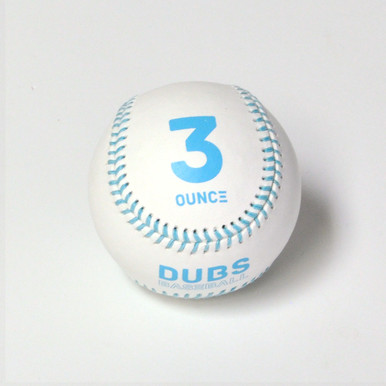
If you already know your working weights, we sell them individually, and browsing the full weighted balls category shows every option we carry.
Best for: beginners who want one set that covers arm-speed work through light overload. Skip if: you already own a set and only need to replace a single ball.
Frequently Asked Questions
Are weighted balls safe for beginner pitchers?
They can be safe when the workload is conservative and the weights are close to a standard five-ounce baseball. Start with lighter and slightly heavier balls, keep throws at low intensity, and stop at the first sign of elbow or shoulder discomfort. Beginners should avoid max-effort throws with heavy balls until they have a base of arm strength and clean mechanics. A coach or athletic trainer can confirm readiness before you add weighted balls to a throwing program.
What weight plyo balls should a beginner pitcher use?
Beginners should stay in a narrow range around the standard five-ounce baseball, roughly three to seven ounces. A set covering three, four, six, seven, and nine ounces gives you options without pushing into heavy overload work too early. Start with the three and four ounce balls for warm-ups and light catch, and use the six and seven ounce balls for short, controlled throws. Hold off on the heaviest balls until mechanics are consistent.
How often should beginner pitchers train with weighted balls?
Two to three short sessions per week is a reasonable starting point, with at least one full rest day between weighted-ball days. Each session should last 10 to 15 minutes and stay well below max effort. Track throwing workload alongside regular practice and game throws so the total volume does not spike. If the arm feels tired or sore the next day, cut the next session short or skip it entirely.
Can weighted balls increase pitching velocity?
Weighted-ball training is widely used to build arm strength and throwing power, and many programs report velocity gains. The results depend on consistent mechanics, adequate recovery, and a gradual progression in workload. Beginners should treat velocity as a long-term outcome, not a weekly target. Measuring accuracy, arm feel, and recovery time gives a clearer picture of progress than radar readings alone.
At what age can a pitcher start weighted-ball training?
There is no universal age cutoff, but most youth programs wait until a player has several seasons of consistent throwing and can demonstrate sound mechanics. For many players that means roughly age 12 or older, and some coaches wait longer. Younger athletes should focus on general arm strength, coordination, and proper warm-up habits first. A parent, coach, and qualified clinician should agree on readiness before starting.
What should a beginner do if their arm hurts during weighted-ball training?
Stop throwing immediately and rest the arm for the remainder of the day. Apply the general rule of not throwing through pain, and avoid testing the arm with more throws to see if it still hurts. If soreness lasts more than a day or two, or if there is sharp pain, swelling, or a loss of throwing range, see a qualified clinician before returning. Bring the training details, including ball weights and throw counts, to that visit.
Weighted-ball training rewards patience and punishes enthusiasm. If you are ready to build a program the right way, Dubs Baseball carries full grain leather weighted baseballs, plyo balls, and arm care gear built for players who train seriously. Get started with Dubs Baseball and give your arm the tools to develop safely.
