

How to Make Youth Baseball Training Equipment Last
Posted by Editorial Team on 2026 Oct 28th
Last Updated: October 28, 2026
Quick Summary
Training equipment durability is the biggest variable in your season budget, because programs lose money re-buying the same item rather than on big purchases. Buy durable gear where size doesn't change, like balls, tees, nets and machines, and check replacement parts before buying. A durable $90 ball bucket costs roughly $105 over three seasons versus $120 for a cheap $40 bucket.
- Squeeze and release a ball: a well-wound ball returns to round immediately.
- Braided knotless netting generally resists abrasion better than knotted netting.
- A tee with a $12 replacement top lasting five seasons beats a sealed tee.
- Pitching machine feed wheels wear faster than any other component.
- Wipe leather balls with a barely damp cloth and air-dry fully before storing.
Table of Contents
- Why Training Equipment Durability Decides Your Season Budget
- Materials and Construction That Hold Up to Daily Reps
- Durability Checks for Hitting Aids, Tees, Nets, and Pitching Machines
- Choosing Baseball Training Equipment for Home Use
- How to Maintain Baseball Training Gear Through the Offseason
- The Best Weighted Plyo Balls for Youth: What Lasts and What Doesn't
- Age, Growth, and Total Cost of Ownership
- Stocking Durable Gear for Your Team or Academy
- Frequently Asked Questions
Why Training Equipment Durability Decides Your Season Budget
Most youth baseball programs don't lose money on big purchases. They lose it on the second and third purchase of the same item. Training equipment durability is the single biggest variable in what your season actually costs, and it rarely shows up on a purchase order. Before you order anything, check shipping and returns.
Materials and Construction That Hold Up to Daily Reps
Durability starts with what's under the cover, and the difference between a bucket that lasts three seasons and one that splits by June is usually visible before you buy. A baseball's lifespan is decided by its leather, its seams, and its winding, not by how it looks in the box. The same logic applies to tees, nets, and pitching machines: the failure point is almost always a joint, a seam, or a replaceable part, not the main body.
Leather, Seams, and Winding: What to Inspect
A practical field test you can run in the store or on arrival: squeeze the ball firmly and release it. A well-wound ball returns to round immediately; a loose-wound ball stays slightly oval. Drop it from shoulder height onto concrete, a dull thud with no bounce usually means dead winding, while a sharp crack and clean rebound means the core is intact. Roll the ball across a flat surface and watch for wobble; a ball that wobbles is already out of round and will only get worse in a machine.
Frame Materials, Joints, and Netting
Netting durability comes down to twine thickness, knot type, and UV treatment. Braided knotless netting generally resists abrasion better than knotted netting because there are no knots to wear against each other. Check stitch density at the perimeter seams, since that is where nets fail first, and confirm whether the manufacturer sells replacement panels or only complete nets.
Repairability and Replacement Parts
Very little baseball gear is truly repairable, which makes replacement parts the real durability story. Nets with replaceable panels, tees with swappable rubber tops, and pitching machines with serviceable feed wheels outlast sealed units. Ask one question before buying: when this wears out, do I replace the whole thing or one component? A tee with a $12 replacement top that lasts five seasons beats a sealed tee that costs less upfront but must be replaced whole. The same math applies to pitching machine feed wheels, which wear faster than any other component and should be user-replaceable.
Durability Checks for Hitting Aids, Tees, Nets, and Pitching Machines
Hitting aids fail at their joints, tees fail at the top, nets fail at the seams, and machines fail at the feed mechanism. Those are the four inspection points that matter. A weighted bat or short bat should feel solid with no rattle when you shake it; a rope bat should show no fraying at the handle connection. Batting tees need a thick rubber top and a weighted base that won't tip on a mishit. For nets, check stitch density and whether the frame uses replaceable poles rather than welded corners. Pitching machines need accessible feed wheels and a housing that sheds dirt. If you're choosing balls for cage and machine work, learn how to choose the right baseballs for batting practice so the ball itself isn't the weak link.
Choosing Baseball Training Equipment for Home Use
For home use, Dubs Baseball offers practice baseballs in a 36-pack bucket. The listing describes these as suitable for tee work and batting practice.

How to Maintain Baseball Training Gear Through the Offseason
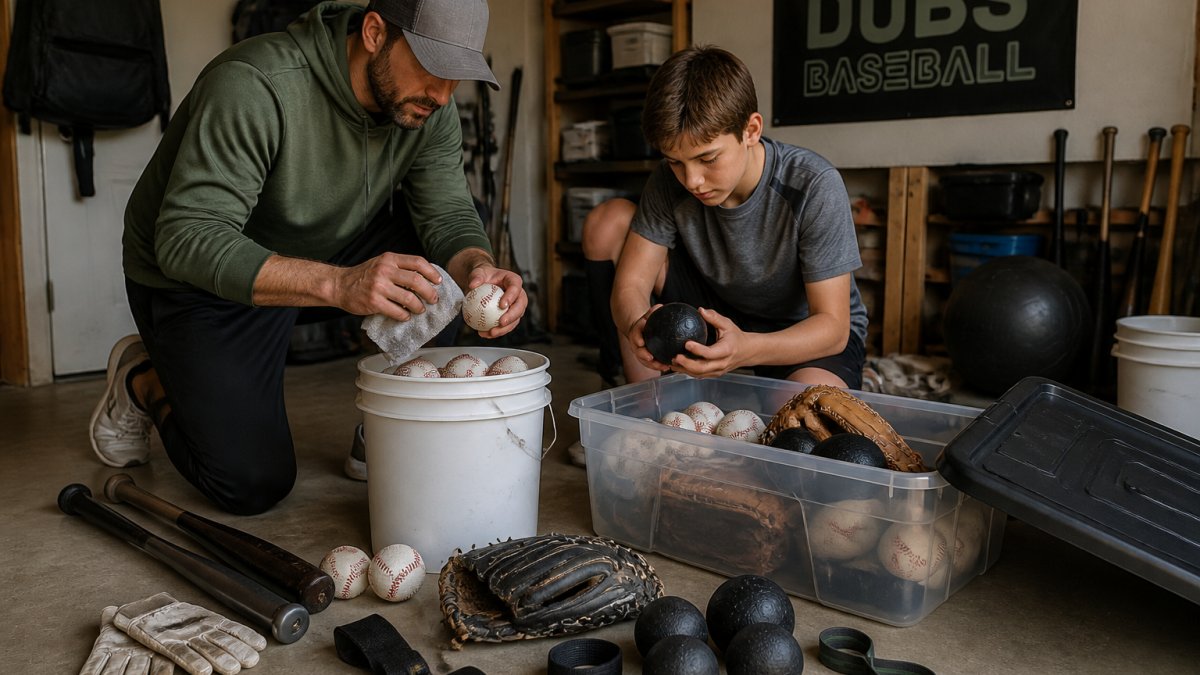
Offseason neglect does more damage than a full season of use. Moisture, UV light, and compressed storage are the three killers.
Storage, Weather, and Inspection Checklist
Run this check at the end of every season:
- Wipe leather balls with a barely damp cloth, then air-dry fully before storing
- Inspect every seam for splitting or loose stitching and pull damaged balls
- Store balls and gloves in a lidded bin, not a garage floor or open shelf
- Keep gear out of direct sun; UV degrades leather and synthetic netting
- Loosen net tension and store frames dry to prevent rust at joints
- Check tee tops and replace cracked rubber before spring
- Wipe down pitching machine feed wheels and clear dirt from the housing
- Store weighted balls separately so they don't compress lighter balls
The Best Weighted Plyo Balls for Youth: What Lasts and What Doesn't
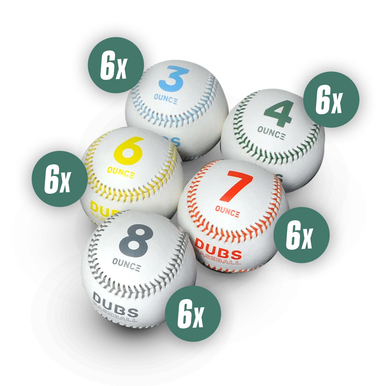
For a program buying in bulk, the DWB-CC-638 bucket with six balls of each weight from 3oz to 8oz includes 30 premium full-grain leather weighted baseballs in five weight categories. The listing describes them for advanced catching and throwing drills, team catcher training, positional throwing exercises, and pitcher training.
DB300-36 - Bucket with 3 Dozen Practice Baseballs →
Age, Growth, and Total Cost of Ownership
Total cost of ownership can include purchase price, replacements, and time lost to broken gear.
A Simple Total Cost of Ownership Worksheet
Run this calculation for any item you expect to use weekly:
- Purchase price, what you pay today.
- Expected replacements per year, based on the failure pattern you've seen or the manufacturer's warranty period.
- Consumables, replacement tee tops, net panels, feed wheels, and balls.
- Warranty coverage, how long the manufacturer stands behind the item and what it excludes.
- Downtime cost, practices canceled or shortened because gear failed.
A worked example using round numbers: a cheap bucket of practice balls at $40 that splits seams in one season costs $120 over three seasons. A durable bucket at $90 that lasts three seasons costs $90 plus maybe one $15 replacement of a few lost balls, roughly $105. The durable option wins by about $15 and avoids two midseason reorders. The gap widens when you factor in shipping, returns, and the practice time lost waiting for a replacement.
Age-Appropriate Sizing vs. Durable Construction
Durable construction and age-appropriate sizing are different questions, and confusing them leads to overspending. A young player should not be using a heavier, tournament-grade bat just because it is built to last, the bat will be outgrown before it wears out. Spend durability dollars on items that don't change size: practice balls, plyo balls, tees, nets, and pitching machine accessories. Spend conservatively on items tied to body size: bats, gloves, cleats, and helmets. For those, buy the correct size for this season and expect to replace it as the player grows.
Warranty and Return Terms Matter
Warranty coverage is part of total cost, and it varies widely. Read the exclusions before buying: many warranties exclude normal wear, seam splits from machine use, and UV damage from outdoor storage. A generous return window matters more than a long warranty for youth gear, because the first month of use reveals most manufacturing defects. Check shipping and returns so you know how a durability failure gets resolved before you commit to a bulk order.
Here is how the article's worked example compares a cheap bucket with a durable one over three seasons.
| Item | Purchase price | Replacements and extras | Three-season cost |
|---|---|---|---|
| Cheap practice ball bucket | $40 | Splits seams in one season | $120 |
| Durable practice ball bucket | $90 | About $15 for a few lost balls | Roughly $105 |
Stocking Durable Gear for Your Team or Academy
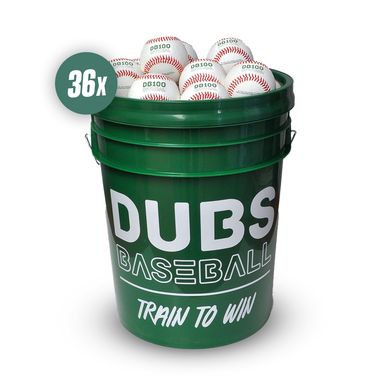
Dubs Baseball offers practice baseballs in a 36-pack bucket and game baseballs in a 36-pack bucket.
Frequently Asked Questions
What materials make baseball training equipment more durable?
Full-grain or high-quality cowhide leather covers hold up best on practice balls, especially when paired with a rubber-covered cork center and wool winding that keeps shape after repeated machine use. On weighted plyo balls, full-grain leather resists cracking better than synthetic covers. For nets, look for thicker twine and reinforced edges. Buckets and carts should have sturdy handles and thick walls so they survive being loaded and hauled between cages and fields.
How often should you replace youth baseball training gear?
Replace gear when performance or safety drops, not on a fixed calendar. Practice balls used in pitching machines and cages wear fastest, so inspect seams and covers monthly during the season. Weighted plyo balls should be retired once the leather cracks or the ball loses its stated weight. Nets need replacing when you see fraying or holes near anchor points. A simple monthly inspection catches most failures before they affect a drill.
How do you maintain weighted plyo balls to ensure they last?
Wipe plyo balls with a damp cloth after outdoor sessions to remove dirt and infield mix, then dry them fully before storage. Keep them out of direct sun and away from car trunks in summer heat, since heat degrades leather. Store them in a bucket or bin rather than loose in a bag where they bang against other gear. Check each ball's weight periodically, and pull any ball with cracked leather or exposed winding out of rotation immediately.
How does weather exposure affect the durability of outdoor baseball training tools?
Sun, rain, and temperature swings shorten the life of nearly every training tool. UV light dries out leather and fades synthetic covers, rain left on seams causes rot, and heat in a closed garage or shed speeds up cracking. Nets left up outdoors degrade fastest at anchor points. Store balls, bands, and weighted gear indoors, bring nets in when not in use, and dry anything that gets wet before it goes back in the bin.
Durability is a choice you make at checkout, not something you fix later. If you're tired of replacing the same gear every season, Dubs Baseball stocks full-grain leather weighted plyo balls, cowhide practice and game baseballs, and the buckets that keep them organized and dry. Get started with Dubs Baseball and build a training kit that survives the season instead of ending it.
