

Best Velocity Training Tools for Hitting and Pitching
Posted by Editorial Team on 2026 Nov 1st
Quick Summary
The best velocity training tools for hitting and pitching are weighted and plyo balls, pitching aids and hitting tools chosen by age, experience and team size. Weighted plyo balls build throwing velocity through controlled overload, while a hitting plyo pack supports bat speed. Use them as a supplement to regular reps, not a replacement.
- Weighted plyo balls build throwing velocity through overload and underload training.
- Dubs Baseball's pitcher set includes six balls from 3.5 oz. to 35 oz. in a carry bag.
- Progress to heavier balls only after weeks of clean, repeatable, pain-free throws.
- The hitting plyo pack includes four each of 250 g, 300 g and 350 g balls.
- Youth players should stay on lighter balls and prioritize mechanics and arm care.
Table of Contents
- Why Velocity Training Tools Matter for Hitters and Pitchers
- How Weighted Plyo Balls Build Throwing Velocity
- Baseball Pitching Training Aids for Mechanics and Control
- Baseball Hitting Training Aids for Bat Speed and Swing Power
- Equipping Your Home Setup With Baseball Training Equipment for Home Use
- Matching Tools to Age, Experience, and Team Size
- Building Your Velocity Training Plan With Dubs Baseball Tools
- Frequently Asked Questions
Last Updated: November 1, 2026
Velocity training tools have become a standard part of serious baseball development, and the right choice depends on who is training and what they need to improve.
Most players do not need every tool on the market. A focused set of well-chosen equipment, used consistently with a clear progression, does more than a cabinet full of gadgets. The sections that follow walk through the reasoning, the tool categories, and a sample plan you can adapt.
Why Velocity Training Tools Matter for Hitters and Pitchers
Velocity training tools exist to give players controlled overload and feedback. A player throws or swings a slightly heavier or lighter implement, the body adapts to that stimulus, and the movement pattern gets rehearsed at game-like speed.
The common mistake is treating velocity tools as a shortcut. They work as a supplement to throwing and hitting reps, not a replacement for them.
How Weighted Plyo Balls Build Throwing Velocity
Weighted plyo balls are the most widely used velocity tool in pitching development because they exploit a principle called overload-underload training.
Plyo work relies on balls whose grip and hand feel stay close to a regular baseball during drills and throwing patterns. That consistency matters: a ball that feels nothing like a game ball teaches the wrong release. Plyo work is usually done as short, high-intensity throws, often after a dynamic warm-up and before regular throwing.
Choosing the Right Weight for Each Training Phase
Weight selection drives the whole program. Lighter balls emphasize speed and mechanics; heavier balls build strength but demand discipline in the arm path. A typical approach moves from lighter to heavier over time, and never adds weight when mechanics break down.
A practical progression most coaches use looks like this:
- Weeks 1-2: 3.5 oz. and 5.3 oz. only, short throws at sub-maximal effort, focused on arm path and follow-through.
- Weeks 3-4: add the 8 oz. ball for a small number of throws, keeping total volume low.
- Weeks 5-6: introduce the 12 oz. ball only if mechanics are clean and the arm is pain-free.
The 35 oz. ball in particular is a heavy implement, it is not a throwing ball for most players and should be used only under supervision for drills that build arm strength, not for max-effort throws.
Workload, Recovery, and Age-Related Precautions
Equipment alone does not increase velocity, the training dose around it does. Most practitioners find that plyo sessions work best as short, focused blocks of roughly 15 to 25 throws, done two to three times per week, with at least one full recovery day between high-intensity throwing days.
Age matters. Youth players whose growth plates are still open should stay on the lighter end of the set and prioritize mechanics, coordination, and arm care over load. High-school athletes can progress through middle weights once their throwing is consistent and pain-free.
The article's weight progression for the pitcher set can be scanned at a glance:
| Phase | Balls used | Note |
|---|---|---|
| Weeks 1-2 | 3.5 oz. and 5.3 oz. | Short sub-maximal throws, focus on arm path |
| Weeks 3-4 | Adds 8 oz. | Small number of throws, low volume |
| Weeks 5-6 | Adds 12 oz. | Only if mechanics are clean and pain-free |
| Later phases | 16 oz. and 35 oz. | For older, experienced athletes; drills, not max-effort throws |
Baseball Pitching Training Aids for Mechanics and Control
Beyond plyo balls, pitching aids help with mechanics and control.
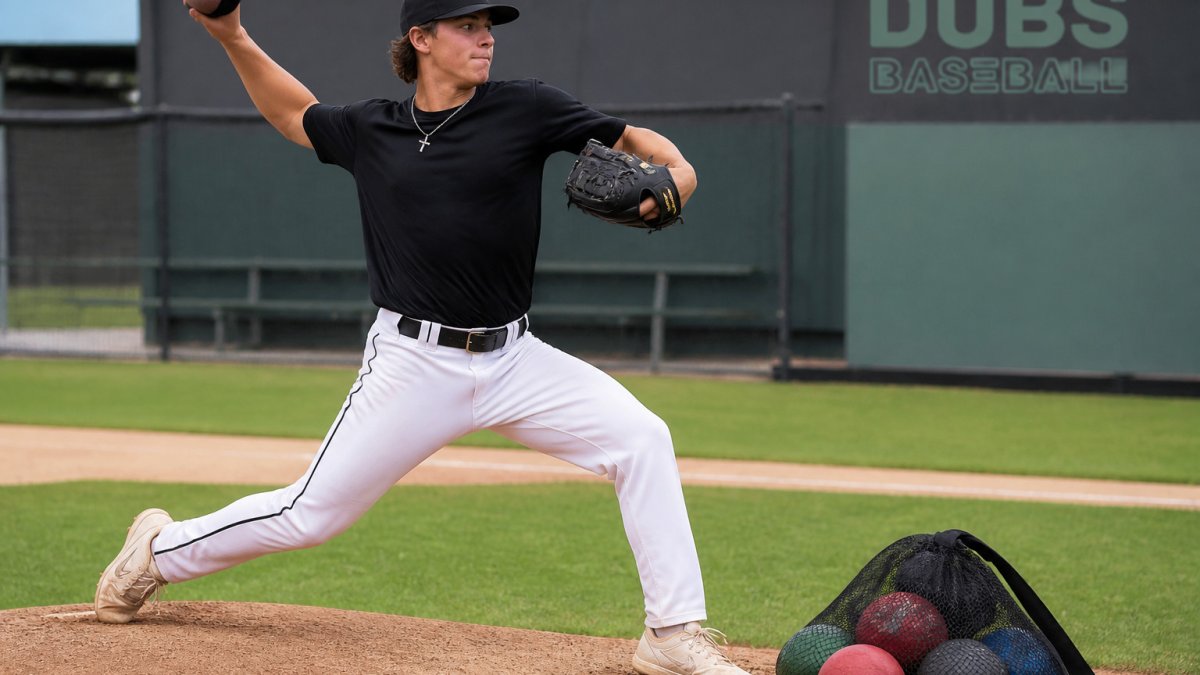
For team settings, a bucket of weighted balls across several weights makes positional throwing and catcher drills easier to run. Dubs Baseball's bucket configuration includes six balls of each weight across 3, 4, 6, 7 and 8 oz., for thirty balls in total.
Arm care also belongs in the plan. Dubs Baseball's arm care band, with a fence hook and medium tension, is a lightweight, compact band for arm care.
Baseball Hitting Training Aids for Bat Speed and Swing Power
Hitting development uses weighted implements in a similar logic: controlled overload, then return to normal speed. Dubs Baseball's hitting plyo pack includes four 250 g balls, four 300 g balls and four 350 g balls.
DPB-6PAC - Pitchers Plyo Ball Set with Carry Bag →
A common pattern is short sets of plyo swings or throws before live hitting, then normal-bat work afterward so the swing returns to game speed.
Equipping Your Home Setup With Baseball Training Equipment for Home Use
Home training is where parents of younger players often start. The most practical home setup is compact: a set of plyo balls for throwing, a weighted ball set for carry work, an arm care band and a bag to keep everything together.
Keep the home plan simple and supervised. Short sessions three to four times a week, with clear stop rules for any arm discomfort, beat occasional long sessions. Parents should confirm age-appropriate weights with a coach before starting.
Matching Tools to Age, Experience, and Team Size
Tool selection should follow three questions: how old is the player, how long have they been training with velocity tools, and how many people will use the equipment at once. Most buyers skip the third question and end up with either a single set that bottlenecks a whole team or a bucket that sits unused in a garage. A simple decision framework fixes that.
A Decision Framework by Player Stage
- Youth players (roughly 5 to 12): prioritize lighter plyo balls, an arm care band, and a compact hitting plyo pack. The goal at this stage is mechanics, coordination, and fun, not load. Skip the heavy end of any set.
- High-school athletes: a pitcher plyo set plus a weighted leather ball set covers most needs. Progress through middle weights once throwing is consistent and pain-free, and add the hitting plyo pack for bat-speed work.
- Experienced older players: the full pitcher set, including heavier implements, plus a hitting pack for rotational power. Heavier tools should be a planned phase, not a daily routine.
Buying Criteria Beyond the Weight Chart
Weight ranges are only one part of the decision. Four other criteria separate a tool that gets used from one that collects dust:
- Space: a home setup needs tools that work without a full net or cage. Plyo balls, an arm care band, and a compact hitting pack fit a garage or backyard; a bucket set is better suited to a field or facility.
- Portability: a mesh carry bag matters more than most buyers expect. Equipment that travels between home, practice, and games gets used far more often than equipment that stays in one place.
- Durability: moulded seams and full-grain leather hold up to repeated use better than stitched or synthetic alternatives, especially for team settings where balls are handled by many players.
Tool choice is also a budget decision. Current prices and quantity options are available on the product pages or from a direct quote. Compare the per-player cost of a bucket against multiple individual sets before committing.
Measuring Progress With Clear Benchmarks
A selection framework is only useful if you can tell whether the tools are working. Establish a baseline before starting and re-measure on a consistent schedule, every four to six weeks is a common interval.
- Throwing velocity: measure with a radar gun under the same conditions each time (same distance, same warm-up, same number of throws).
- Bat speed: use a swing sensor or video analysis at the same tee or front-toss setup.
- Strike accuracy: track how many of a fixed number of throws hit a target zone, and note repeatability rather than one lucky streak.
Start with the tools that match your player's age and current stage, follow a consistent weekly schedule, and let mechanics dictate when to advance. Explore the Dubs Baseball catalog to match the right set to your goals and budget.
Building Your Velocity Training Plan With Dubs Baseball Tools
A practical plan combines a warm-up, plyo work, normal throwing or hitting, and a cooldown. A sample weekly structure for a competitive high school pitcher might look like this:
- Two sessions per week with the pitcher's plyo set, lighter weights, short throws focused on follow-through
- One session with weighted catch or carry work from the leather set, emphasizing accuracy
- Arm care band work at the end of each throwing day
Progress by tracking mechanics first, then velocity if you have a radar gun or similar measure. Move to the next weight only after several weeks of clean, repeatable throws.
Start with the tools that match your player's age and current stage, follow a consistent weekly schedule, and let mechanics dictate when to advance. Explore the Dubs Baseball catalog to match the right set to your goals and budget.
Frequently Asked Questions
What equipment do baseball players need for hitting and pitching practice?
A basic setup covers game and practice baseballs, a bucket or carry bag for storage, a set of weighted plyo balls for arm and swing work, and resistance bands for warm-up and arm care. Hitters add a tee or front-toss station and training bats. Pitchers add a target and weighted balls for arm strength drills. Start with the tools that match your current practice routine, then add specialized items as your training plan grows.
Do weighted baseballs help improve pitching velocity?
Weighted baseballs are used by many coaches as part of arm strength programs, but the results depend on how they are used. Lighter and heavier balls are typically thrown in controlled sets, with the weight progressed gradually over time. Velocity gains depend on mechanics, conditioning, and recovery as much as on the tool itself. Pitchers should work with a coach to set a safe volume and rest schedule, especially younger players whose arms are still developing.
What are the best tools for increasing pitching velocity?
The most common tools for pitching velocity work are weighted plyo balls for arm strength, resistance bands for rotator cuff and arm care, and a practice target for accuracy-based throwing. Mechanics drills and a consistent long-toss program support the same goal. The right combination depends on the player's age, experience, and training goal. Dubs Baseball offers weighted plyo balls in multiple weights and an arm care band with medium tension.
How often should pitchers use velocity training tools?
Most coaches schedule weighted ball work a few times per week rather than daily, with full rest days built in. Session length and volume should be kept modest, and the progression should move slowly from lighter to heavier balls. Recovery, rest days, and arm soreness all affect how much work is appropriate. Younger players should follow guidance from a qualified coach or medical professional. Check Dubs Baseball's website for current prices.
How can baseball players train hitting and pitching at home?
A home setup can cover both hitting and pitching with a small set of tools. Plyo balls work for tee and front-toss drills, and weighted bats or lighter training balls help build bat speed. For pitching, a target, weighted balls, and resistance bands handle arm strength and accuracy. Space and safety matter, so choose drills that fit the area.
What training aids help improve bat speed?
Bat speed work usually combines weighted or lighter training balls with tee, front-toss, and swing drills. Hitting plyo balls, used for tee work or front toss with both normal and weighted bats, are a common choice. The goal is to swing with intent while keeping mechanics sound, so drill selection matters more than tool count. Dubs Baseball's hitting plyo pack includes balls in three weights.
How do you choose baseball training equipment for different skill levels?
Match the tool to the player's age, strength, and training goal. Younger or less experienced players usually start with lighter balls and simple accuracy drills, while advanced players may progress to heavier weights and more demanding routines. Coaches running team drills should also consider durability and quantity.
