

Baseball Arm Bands for Recovery: A Buyer's Guide
Posted by Editorial Team on 2026 Oct 14th
Table of Contents
- Why Baseball Arm Bands Matter for Recovery
- Baseball Band Exercises for Pitchers and Fielders
- Building a Baseball Arm Care Routine with Bands
- Resistance Band Exercises for Shoulder Mobility
- Choosing the Right Baseball Resistance Bands for Pitchers
- Common Mistakes and Safety Considerations
- Frequently Asked Questions
Last Updated: October 14, 2026
Why Baseball Arm Bands Matter for Recovery
Arm care is foundational for baseball players who want to stay healthy and perform at their best, and baseball arm bands recovery is a proven method to achieve this. Whether you're a pitcher throwing multiple times per week or an outfielder making long throws, your throwing arm experiences significant stress. Baseball arm bands for recovery provide targeted resistance that strengthens the muscles supporting your shoulder and elbow while improving mobility and reducing injury risk.

Neglecting arm care leads to injury. Pitchers especially face rotator cuff strain, elbow tendinitis, and shoulder impingement when they skip conditioning. Recovery-focused bands build muscular endurance in the decelerators, the muscles that slow your arm after release.
Recovery is about preventing problems before they start. A structured band routine takes 10-15 minutes daily and can add years to your career. Graduated resistance matches your strength level, making bands effective from youth players through college athletes.
Baseball Band Exercises for Pitchers and Fielders
Pitchers benefit most from band exercises targeting internal and external rotation, but fielders need this work too. The distinction is volume: pitchers do more repetitions and higher intensity because they throw harder and more often.
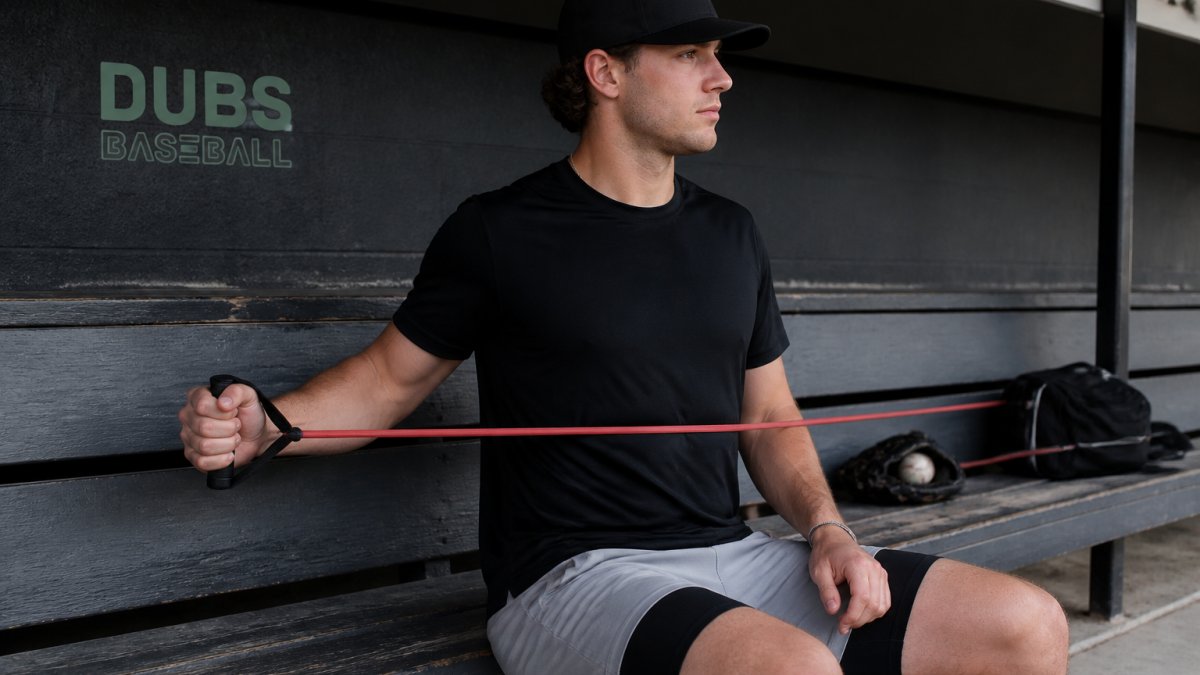
External rotation at 90 degrees is the cornerstone exercise for pitchers. Attach a band to a fence at shoulder height, stand perpendicular, and rotate your forearm outward against resistance. This strengthens the rotator cuff muscles that decelerate your arm after release.
Internal rotation complements external work by building balanced strength. Face the fence with the band at shoulder height and rotate your forearm inward, targeting the muscles that stabilize your shoulder during throwing.
Rotation at zero degrees (arm at your side) addresses the lower rotator cuff and is often overlooked.
Fielders can follow a similar protocol with lighter resistance and fewer reps since they throw less often. The goal is the same: build endurance and stability for healthy throwing mechanics.
Building a Baseball Arm Care Routine with Bands
Most band content treats arm care as one blob: warm up, do rotations, throw. That misses the point of a recovery band. Recovery work follows different rules than pre-throw activation or strength work, run the same routine for all three and you'll either under-recover or over-fatigue the arm.
Here's how to separate them.
Three distinct band sessions (don't blend them)
1. Pre-throw activation (5-7 minutes). Light resistance only, the goal is blood flow and neuromuscular wake-up, not fatigue. Two sets of 15 external rotations at 90 degrees, two sets of 15 internal rotations, and a set of band pull-aparts.
2. Post-throw recovery (8-12 minutes). This is the session where baseball arm bands recovery truly shines. Wait 20-30 minutes after throwing so acute inflammation settles, then use light bands for high-rep, low-load work.
A practical post-throw circuit:
- External rotation at 0 degrees (arm at side): 2 x 20, light band
- Internal rotation at 0 degrees: 2 x 20, light band
- Band pull-aparts: 2 x 20
- Banded sleeper stretch: 2 x 30 seconds per side
- Banded cross-body stretch: 2 x 30 seconds per side
Rest 30-45 seconds between sets. Total time: about 10 minutes. No exercise in this block should feel like a workout.
3. Off-day strength work (12-15 minutes). This is where medium and heavy bands belong: external and internal rotation at 90 degrees, zero-degree rotations, scapular retraction, and, for advanced players, plyometric band work. 3 sets of 12-15 with controlled tempo. This session builds the decelerator strength that protects the arm long-term.
Timing rules that matter
- Post-throw recovery bands: same day, within 2 hours of throwing. Waiting until the next morning loses most of the stiffness-reduction benefit.
- Off-day strength bands: 24-48 hours after a heavy outing. Never the day before a start.
- Pre-throw activation: 10-15 minutes before your first throw. Not 45 minutes before, the effect fades.
- Rest days: If you threw hard yesterday, a 5-minute light-band flush is fine. Skip the strength block entirely.
Weekly template by role
| Role | Pre-throw | Post-throw | Off-day strength |
|---|---|---|---|
| Starting pitcher | Every throwing day | Every throwing day | 2x per week |
| Relief pitcher | Every appearance | Every appearance | 1-2x per week |
| Position player | Every throwing day | After long-toss or high-effort days | 2x per week |
| Youth (12U) | Every practice | After games | 1-2x per week, light only |
What recovery bands cannot do
Bands do not repair a torn labrum, replace sleep and nutrition, or substitute for a proper throwing program. They manage stiffness and maintain tissue quality between outings. Using them to push through pain is using them wrong, see the safety section below.
Resistance Band Exercises for Shoulder Mobility
Shoulder mobility directly impacts throwing mechanics and injury risk. Tight shoulders force compensatory patterns that stress the elbow and rotator cuff. Bands improve mobility by working joints through their full range of motion under controlled load.
Band pull-aparts target the rear shoulder and upper back. Hold a band at shoulder width and pull your hands outward, activating the muscles that retract your shoulder blade and stabilize the shoulder during throwing.
Banded shoulder dislocations are uncomfortable but effective. Hold a band with a wide grip and slowly rotate it overhead and behind your back, then return.
Sleeper stretch with band assistance amplifies the traditional version. Lie on your side with your shoulder at 90 degrees and use a band looped around your forearm to deepen the stretch.
Bands also facilitate lat stretches and thoracic rotations, improving overall shoulder function. A mobile shoulder requires work across multiple planes of motion, and bands reinforce these patterns.
Choosing the Right Baseball Resistance Bands for Pitchers
Most "best arm bands" pages either list products with no criteria or explain criteria with no products. This section does both: five criteria that matter for a recovery band, then how the five common formats stack up.
DJB-100 - Arm Bands with Fence Hook - Medium Tension for High School Players →
The five criteria that matter for recovery use
1. Resistance range and adjustability. Recovery work needs light tension, typically 2-8 lb at working length. A band that only comes in "medium" or "heavy" is a strength tool, not a recovery tool.
2. Durability and material. Latex and natural rubber hold tension longer than cheap TPE blends. Look for layered or reinforced construction and a stated shelf life. Bands stored in a hot car or sunny dugout degrade fast regardless of brand.
3. Comfort at the anchor point. Recovery sessions run 8-12 minutes with the band anchored to a fence, net, or door.
4. Portability. The best recovery band is the one in your bag. Flat loop and carabiner tube bands pack smaller than a softball. Door-anchor kits are convenient at home but useless at the field.
5. Included instructions and exercise guidance. A recovery band without a printed or linked protocol gets used twice and forgotten.
How the five common recovery-band formats compare
Flat loop bands (light tension). Cheapest entry point, widely available, easy to store. Downside: fixed tension per band, so you need 2-3 loops to cover activation and recovery. Best for youth players and travel bags.
Tube bands with handles. More comfortable grip, easier tempo control, and handles make external rotation at 90 degrees more repeatable. Downside: bulkier, and handles can encourage momentum.
Bands with a fence hook or door anchor. The most practical format for field use: setup takes seconds, tension is consistent, and the anchor sits at the right height for shoulder-height rotations.
Figure-8 / crossover bands. Good for scapular work and pull-aparts, less useful for isolated rotation. A complement, not a primary recovery band.
Banded stretch straps (sleeper stretch, cross-body). Not traditional resistance bands, but they belong in a recovery kit because they handle the mobility half of the post-throw circuit. Buy one if your kit lacks a stretch strap.
A practical buying decision
- Youth (8-12): one light flat loop band plus a stretch strap. Under $25 total in most cases.
- High school (13-17): a light/medium tube band set with handles, plus a fence-hook band for field work.
- College and adult: a full kit, light tube band for recovery, medium and heavy bands for off-day strength, fence hook, and stretch strap.
What to ignore in marketing copy
"Pro-grade," "used by MLB players," and "increases velocity" are not selection criteria. No band increases velocity on its own, velocity comes from mechanics, strength, and maturation. A band's job is to keep the arm healthy enough to keep throwing. Judge bands on resistance range, durability, comfort, portability, and whether they come with a routine you'll follow.
Resistance band safety and inspection guidance
Common Mistakes and Safety Considerations
The most common mistake is poor form. Players rush through reps using momentum instead of muscular control, reducing effectiveness and increasing injury risk.
Another mistake is skipping the warm-up. Cold muscles and joints don't respond well to loaded movement. Always spend 5 minutes warming up before band work.
Overtraining is real. Some players do band work twice daily or perform excessive volume, creating fatigue that paradoxically increases injury risk. Moderate, consistent arm care beats aggressive, inconsistent work every time.
Pain is a signal to stop. Discomfort during stretching or light band work is normal; sharp pain is not.
Players also neglect mobility work. Bands build strength, but strength without mobility creates movement restrictions. Include stretching and mobility drills alongside your band exercises.
Finally, many players underestimate consistency. Arm care only works if you do it regularly, missing days breaks the habit and reduces the cumulative benefit.
Arm health is the foundation of a long baseball career. The Dubs Baseball arm bands with fence hooks, available in medium tension for developing players and heavy tension for advanced athletes, make it simple to incorporate quality arm care into your routine.

Frequently Asked Questions
How often should baseball players use arm bands for recovery?
Most pitchers and position players benefit from daily arm-care work with resistance bands, especially during the competitive season. A typical routine takes 10-15 minutes and works best as part of a pre-throw warm-up or post-game recovery protocol. Frequency depends on throwing volume: high-volume throwers may use bands daily, while recreational players can use them 3-4 times per week. Stop immediately if you experience sharp pain, discomfort signals that rest or professional assessment is needed.
What is the difference between light and heavy resistance baseball bands?
Light and medium tension bands suit younger players, those new to arm-care training, and rehabilitation phases. Heavy resistance bands are designed for advanced high school and college players with established arm strength and conditioning. Choosing the wrong tension can reduce effectiveness or increase injury risk. Medium-tension bands like the DJB-100 work well for high school players building foundational strength, while the DJB-300 heavy-tension option suits advanced athletes ready for intensified training loads.
Can resistance bands help prevent baseball injuries?
Yes. Consistent band work strengthens the rotator cuff, improves shoulder stability, and enhances throwing mechanics, all key injury prevention factors. Bands address the muscles that decelerate the throwing arm, reducing stress on joints. However, bands are one part of a complete arm-care program that includes proper throwing mechanics, adequate rest, and gradual load progression. Players who skip band work or ignore pain signals remain at higher injury risk regardless of equipment quality.
What makes a good baseball arm care band?
Quality arm bands are durable, maintain consistent resistance through repeated use, and come with secure attachment options like fence hooks for stable positioning. Lightweight, portable designs allow players to train at home, the field, or the gym. Bands should support exercises targeting internal rotation, external rotation, and shoulder mobility without tearing or losing elasticity. Dubs Arm Care Bands are engineered specifically for baseball, with heavy-duty materials built to withstand the repetitive demands of pitchers and fielders at all competitive levels.